Optimising prompt creation with semantic blocks to maximise LLM accuracy.
A modular system that turns the blank prompt page into a flow guided by Tags and a visual Canvas — designed for people who have never heard of prompt engineering.
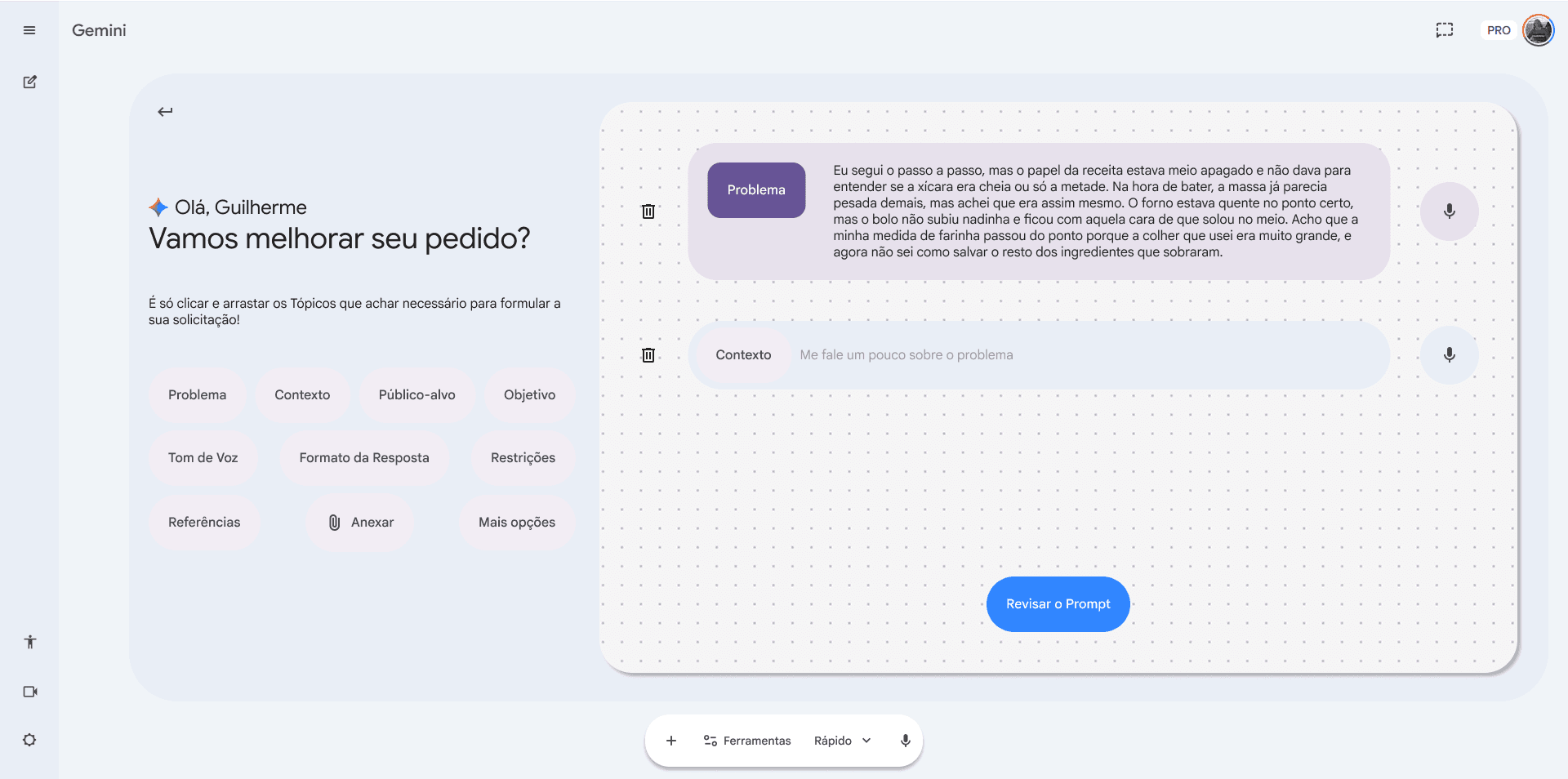
The Problem
Cognitive overload (the blank-page syndrome)
Non-technical users freeze in front of the Gulf of Execution: they know what they want, but can't translate intent into a clear command for the AI.
Friction and rework
Without structure, every request takes several iterations to reach the desired answer — which creates frustration and flow abandonment.
The invisible cost of a prompt
Poorly written prompts stretch rework cycles, increase latency and inflate token consumption. Optimising the input can cut the bill by up to 40%.
In-depth interviews showed that AI appears at several stages of people's workflows — but the lack of familiarity with prompt engineering makes requests lose clarity and detail, limiting the tool's potential.
The Solution
Modular prompt system
The user picks thematic blocks that automatically generate context and structure, with no prompt-engineering knowledge required.
Multi-tool Canvas
A visual space to drag Tags around and add inputs, attachments and references. Abstraction becomes tangible.
I turned the complexity of prompt engineering into a visual, guided process. Instead of a blank screen, the user fills in a smart form structured by Tags — Goal, Context, AI Role and Expected Output — and the interface organises that data into a Canvas, delivering an optimised request to the LLM.
Results
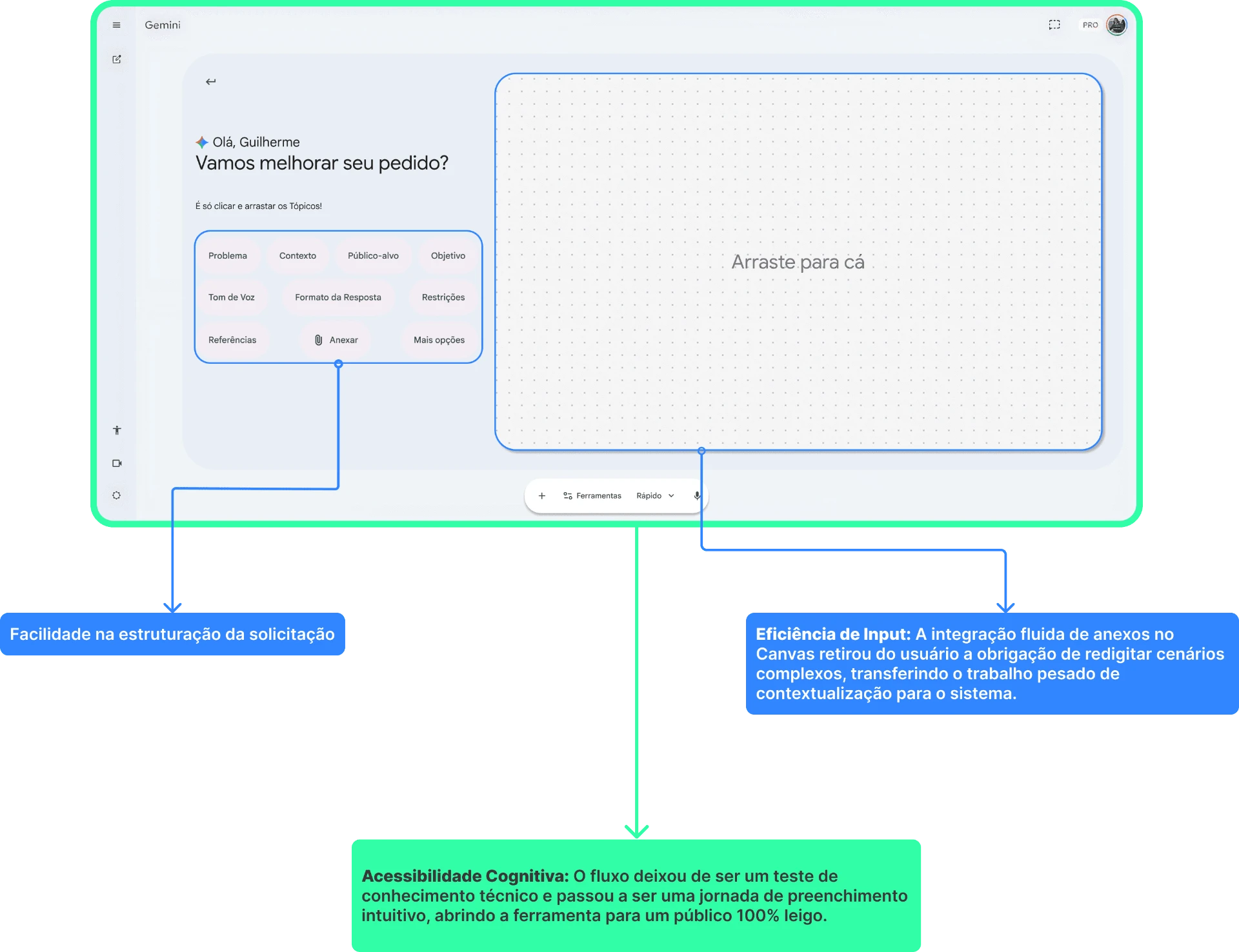
Easier structuring
The blocks guide users step by step, reducing the effort of writing from scratch.
Input efficiency
Attachment support inside the Canvas removed the need to describe complex scenarios — heavy context moves to the system.
Cognitive accessibility
The flow stopped being a test of technical knowledge and became an intuitive journey, open to a completely non-technical audience.
Next Steps
If the product were running in production, these would be the three hypotheses I would measure to validate success:
- 01.
Task Success Rate
What share of users get the answer they want from the AI without rewriting the prompt?
- 02.
Time on Task
Is filling in Tags and attaching files faster than writing free text and fixing the AI's mistakes?
- 03.
Token spend
How much can we reduce token consumption per interaction with the platform?
Challenges and Learnings
The friction paradox
The biggest challenge was turning a free-form flow into a guided process without making the task feel tedious. The learning: structured blocks reduce cognitive load and, in practice, make the task feel faster.
Qualitative discovery
The problem was diagnosed and grounded in real user interviews — making sure the design solves a latent pain, not an assumption.
What comes next
With more resources, the natural step would be usability testing to compare Time on Task between the old model and the new Canvas.
// Next project
Solving information fragmentation for physiotherapists.